The transmission is the part of your Audi that turns engine power into road speed, choosing a ratio for every moment you are driving. It is also the component most affected by where that driving happens. An A4 covering long, steady runs in a temperate climate and an A4 doing short hops between the industrial blocks of Musaffah are asking two very different things of the same gearbox.
That matters because Audi builds four quite different transmission platforms, and each one ages differently in Abu Dhabi conditions. Knowing which is fitted to your car tells you what to watch for, what it costs to maintain, and when a symptom is worth acting on rather than living with.
How an Audi Transmission Actually Works
The gearbox takes power from the engine and delivers it to the driven wheels at a usable ratio. Press the accelerator and engine speed rises; the transmission selects a higher ratio to match. Lift off or slow down and it steps back down again.
On a modern Audi almost none of this is mechanical guesswork. A transmission control unit reads wheel speed, throttle position, engine load, fluid temperature and gear-selector input, then commands the shift through solenoids and hydraulic circuits. That is why a transmission fault is so often an electronic or hydraulic fault rather than a broken gear, and why the early symptoms tend to be shift quality problems long before anything sounds mechanical.
It also means the gearbox keeps a record. The control unit stores fault codes, clutch wear counters and adaptation values, so reading the module data usually identifies the failing part precisely rather than by elimination.
The Four Audi Gearbox Platforms
Audi has used four gearbox families across its range. The one in your car determines its maintenance schedule, its typical failure modes and what a repair costs. If you are not certain which you have, the platform breakdown covers how to identify it from the model and build year.
Manual Gearbox
What it is: a conventional gearbox where the driver selects each ratio with a clutch pedal and lever.
Why owners like it: a simple design with fewer moving parts, which keeps maintenance and repair costs down.
Where you will find it: older Audi models and entry-level cars across the A3 and A4 range.
Service interval: clutch inspection every 50,000 to 60,000 miles, with gear oil checked and replaced against the manufacturer's schedule.
In Abu Dhabi the clutch is the wear item that goes first. Repeated pull-aways in slow traffic put far more heat through the friction plate than open-road driving, and heat is what kills clutches.
Tiptronic Torque-Converter Automatic
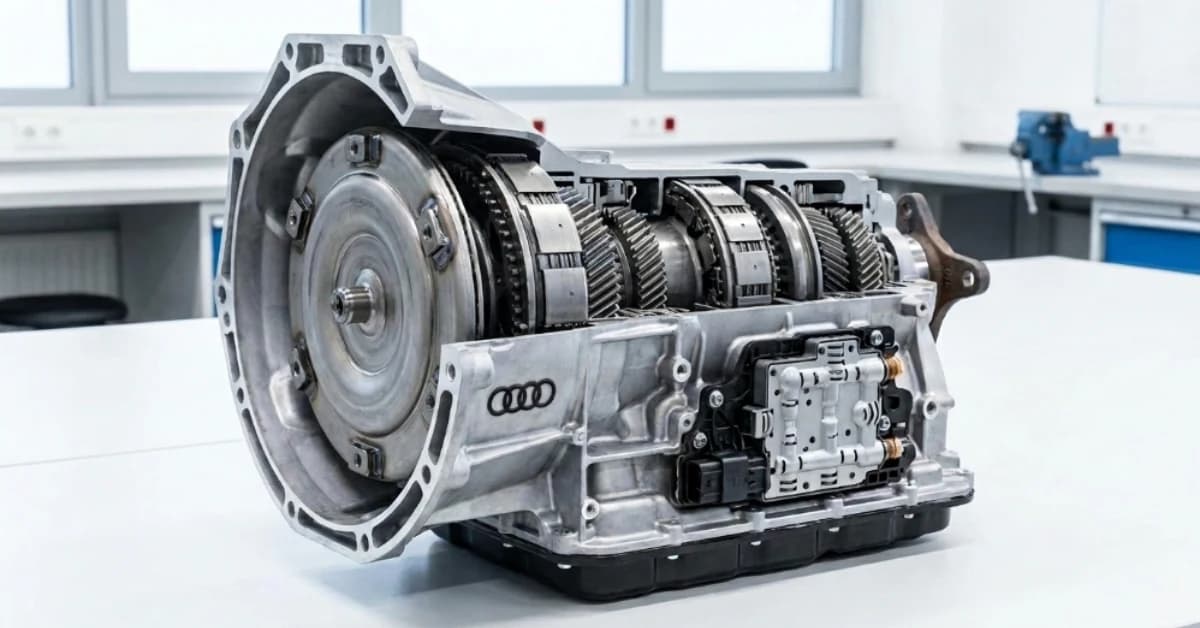
What it is: a self-shifting automatic that reads road speed and engine load to select the ratio, with a manual mode on the lever or paddles.
Why owners like it: smooth, quiet changes that suit both city traffic and long highway runs.
Where you will find it: many A6, A7 and A8 models, plus a number of older Q-series cars.
Service interval: fluid replacement every 40,000 to 60,000 miles depending on conditions and model year.
Take the lower end of that range seriously here. The torque converter generates its heat when it is slipping, which is exactly what it does pulling away and crawling, so a car that lives in Musaffah traffic reaches the same fluid condition in far fewer miles than the interval assumes.
S tronic Dual-Clutch
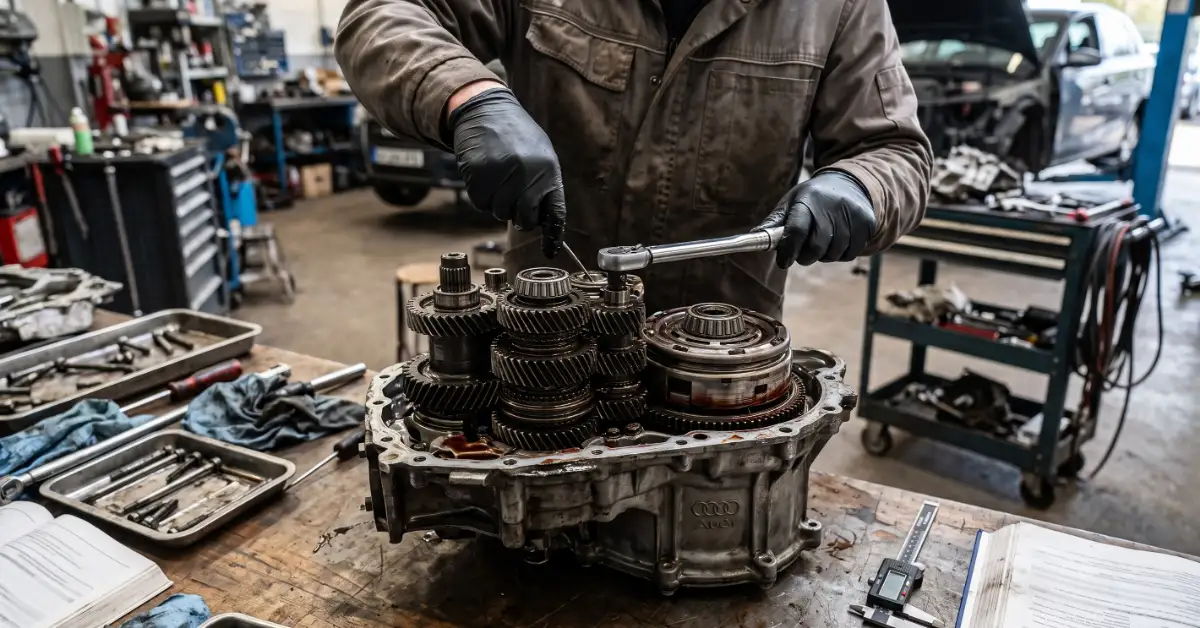
What it is: effectively two gearboxes in one housing. One clutch handles the odd gears, the other the even ones, so the next ratio is already engaged before the shift happens.
Why owners like it: near-instant changes and strong efficiency, with a noticeably sportier feel than a torque-converter automatic.
Where you will find it: most S and performance models, including the A3, TT, S3, S4 and much of the RS range.
Service interval: fluid and filter every 40,000 miles. Skipping it leads to rough engagement and eventually to internal damage.
The S tronic's weak point in this climate is the mechatronic unit, the combined hydraulic and electronic module that operates the clutches. It sits in the hottest part of the assembly, and degraded fluid is the fastest route to a mechatronic fault. Most S tronic repairs that arrive at the workshop started as a fluid service that was postponed.
Multitronic CVT
What it is: a continuously variable transmission using a steel belt between two adjustable pulleys instead of fixed gears, so there are no shift steps at all.
Why owners like it: completely smooth acceleration, with the engine held at its most efficient speed.
Where you will find it: mainly front-wheel-drive A4 and A6 models where comfort and economy were the priority.
Service interval: CVT fluid every 30,000 to 40,000 miles, and the fluid specification is not negotiable, because the belt and pulley design depends on it.
Of the four platforms this is the one least tolerant of the wrong fluid or a stretched interval. Chain wear on a Multitronic is not economically repairable once it has gone far enough, which makes it the clearest case for servicing on time rather than on symptoms.
What Abu Dhabi Driving Does to a Gearbox
Manufacturer service intervals are written for average conditions. Abu Dhabi is not average, and three local factors move the real interval closer than the book suggests.
- Ambient heat. Summer temperatures push automatic transmission fluid well beyond the range it was formulated for. Heat is what breaks ATF down, and once its properties shift, hydraulic pressure and clutch engagement go with it.
- Stop-start running. The short, low-speed journeys typical of Musaffah, ICAD and the surrounding industrial blocks keep a gearbox in its hottest duty cycle: repeated engagement, never enough sustained airflow to cool properly.
- Dust and short trips. Fine airborne dust and journeys too short to bring the fluid to a stable operating temperature both shorten service life, particularly on dual-clutch units.
The practical consequence is simple: treat the shorter end of every interval above as the real one, and do not wait for a symptom to book a service.
Symptoms Worth Acting On
Most transmission repairs are cheaper when they are caught as a shift-quality complaint rather than a mechanical one. The signs that justify a diagnostic scan are:
- Rough or delayed engagement, particularly from Park to Drive on a cold start
- Slipping: engine speed rising without a matching increase in road speed
- A transmission or check-engine warning on the instrument cluster
- Grinding or whining from the gearbox under load
- Fluid leaks beneath the car at the pan or driveshaft seals
None of these are self-correcting, and continuing to drive with an active fault normally widens the repair. The common fault patterns are worth reading if you are trying to work out how urgent a symptom is.
Keeping an Audi Gearbox Healthy in Musaffah
Maintenance on these units is not complicated, but it is unforgiving of neglect. Service the fluid to the shorter interval for the conditions, use the exact specification Audi lists for your platform rather than a universal ATF, and avoid the habits that add heat: aggressive pull-aways, riding the brakes in traffic, towing in peak temperatures.
When something does change in how the car shifts, have it read properly rather than replaced speculatively. Module-level diagnostics identify which component has failed, which is the difference between replacing a solenoid pack and replacing an assembly. That is the case for using a gearbox specialist in Musaffah rather than a general garage: the diagnosis, not the labour rate, is what determines the bill.