Most drivers never think about what happens between pressing the accelerator and the car picking up speed. That is a compliment to the engineering, but it also means the first sign that something is wrong is often dismissed as a quirk rather than a symptom.
Understanding roughly how the gearbox works makes those signals readable. It also explains why a transmission complaint in Abu Dhabi so often traces back to heat and fluid condition rather than to broken metal.
What a Transmission Does
The transmission controls how much of the engine's power reaches the wheels, and at what ratio. Without it the engine would either labour at low speed or over-rev at high speed.
The bicycle comparison holds: a low gear for pulling away, a high gear for cruising. An Audi does the same thing, but the selection is made by a control unit reading road speed, throttle position, engine load and fluid temperature many times a second, and adjusting for how the car is actually being driven.
Which gearbox you have determines how that selection is made mechanically. If you are unsure which is fitted, the platform guide identifies them by model and build year.
S tronic: Two Gearboxes in One Case
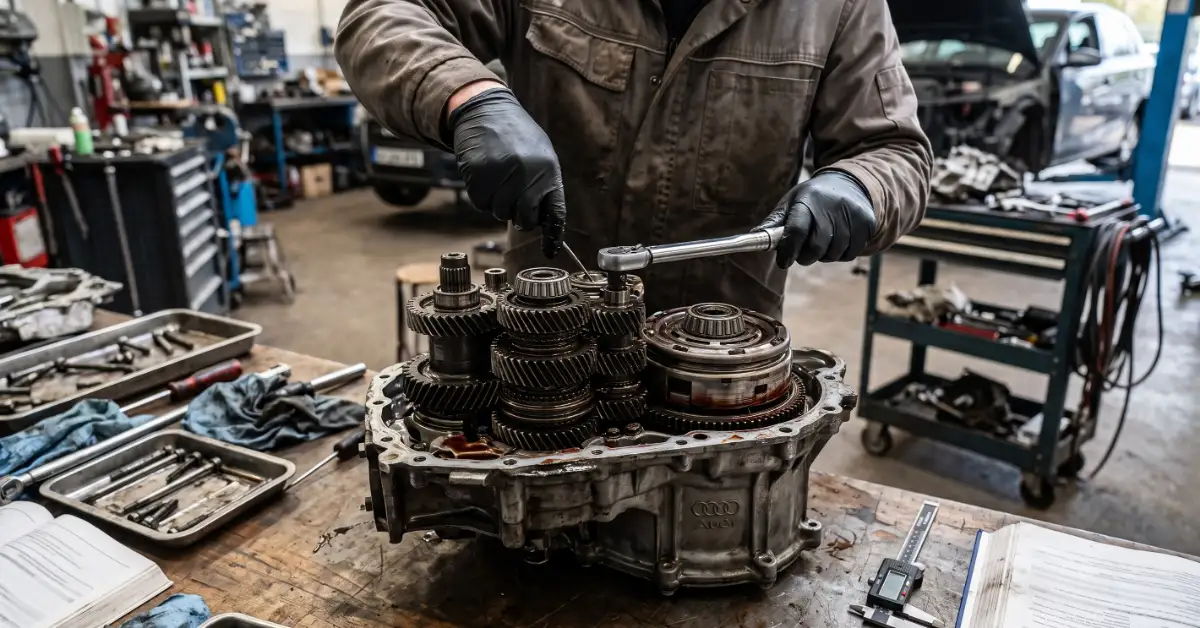
The S tronic is a dual-clutch design. One clutch carries the odd gears (first, third, fifth, seventh) and the other carries the even gears plus reverse.
While you are driving in third, the system has already engaged fourth on the idle clutch. When the shift comes, it releases one clutch and takes up the other simultaneously. The change takes a few hundredths of a second and power delivery barely interrupts.
That design is also why the S tronic is sensitive to fluid condition. Both clutches and the hydraulics that operate them depend on fluid at the correct specification and viscosity. In Abu Dhabi's heat that fluid degrades faster than the service book assumes, and degraded fluid shows up first as hesitation at low speed, exactly the traffic you meet crossing Musaffah.
Tiptronic: The Torque-Converter Automatic
The Tiptronic uses a torque converter rather than a clutch. The converter is filled with hydraulic fluid that transmits power from the engine to the gearbox, connecting and disconnecting according to speed and throttle.
Manual mode lets the driver select gears with the lever or paddles without losing the convenience of an automatic. It will still shift for you if you push the engine too far.
Torque converters generate their heat when slipping: pulling away, crawling, manoeuvring. A car that spends its life in short industrial-estate journeys works its converter far harder than one covering the same mileage on the E11, which is why local fluid intervals should sit at the shorter end of the range.
Multitronic: Continuously Variable
The Multitronic has no fixed gears. A steel belt runs between two cone-shaped pulleys; as one widens the other narrows, changing the ratio continuously rather than in steps.
The control unit reads speed and throttle constantly and adjusts pulley width to hold the engine at its most efficient point. The result is acceleration with no shift steps at all, which suits relaxed driving in front-wheel-drive models.
The trade-off is intolerance. The belt-and-pulley arrangement depends entirely on the correct fluid, and chain wear on a neglected Multitronic is rarely economic to repair. Of the four platforms this is the one where a missed service costs the most.
The Mechatronic Unit: The Part That Decides
Every modern Audi gearbox contains a mechatronic unit, which puts electronic sensors and hydraulic valves in a single module sitting inside the transmission. It is the component that decides when to shift and then physically carries the shift out.
It monitors continuously:
- Road speed, to judge whether a ratio change is due
- Accelerator position, to read how much power you are asking for
- Engine speed, so the shift lands without stressing the engine
- Fluid temperature and pressure, which govern how firmly the clutches engage
Because it is both electronic and hydraulic, a mechatronic fault can present as a shift problem, a warning light, or both. It is also the single most common expensive failure on high-mileage S tronic cars in this climate, and almost always preceded by fluid that was left too long.
The useful consequence is that the unit keeps records. Fault codes, clutch wear counters and adaptation values are all stored, so an Audi workshop in Abu Dhabi that reads the module data can identify the failed component instead of replacing parts by elimination.
What Musaffah Driving Does to the System
Three things about local conditions matter more than mileage:
- Sustained ambient heat. Summer temperatures leave the fluid running near the top of its designed range before the car has even moved.
- Short, slow journeys. Runs between the industrial blocks keep the clutches and converter in their highest-wear phase and never give the fluid a settled cruising temperature.
- Fine dust. It shortens the life of coolers, seals and breathers, all of which contribute to keeping fluid temperature under control.
None of this makes an Audi gearbox unreliable here. It does mean that servicing to the calendar rather than to symptoms is the difference between a fluid change and a mechatronic replacement.
Signs Your Gearbox Needs Attention
- Delayed or rough changes. Hesitation before a shift, or a jolt as it lands, usually means worn components or fluid that is past its useful life.
- Grinding or whining. Grinding suggests worn gears; a whine more often points to fluid condition or bearings.
- Slipping out of gear. Losing drive, or the car dropping into neutral by itself, is a safety issue and should stop further driving.
- A burning smell. Overheating fluid. Old or low fluid cannot carry heat away, and the temperature climbs until something is damaged.
- A warning light. The sensors detect gearbox faults early. A transmission or check-engine light is the car reporting something it has already measured.
The full symptom list goes further into which of these are urgent. If you want the underlying mechanics first, the introduction to Audi transmissions covers the fundamentals.
The Practical Takeaway
Whichever platform your car uses, the maintenance principle is the same: keep the fluid within specification and within interval, and have any change in shift behaviour read properly rather than guessed at.
Transmission work rewards accurate diagnosis more than almost any other job on a car. Knowing whether a symptom is a solenoid, a clutch pack, an adaptation value or a failing mechatronic unit is the difference between a few hours of labour and a replacement assembly.
Audi is not the only make solving this problem, and the solutions differ. How Audi compares to its rivals covers what BMW and Mercedes do differently and where each approach struggles.