
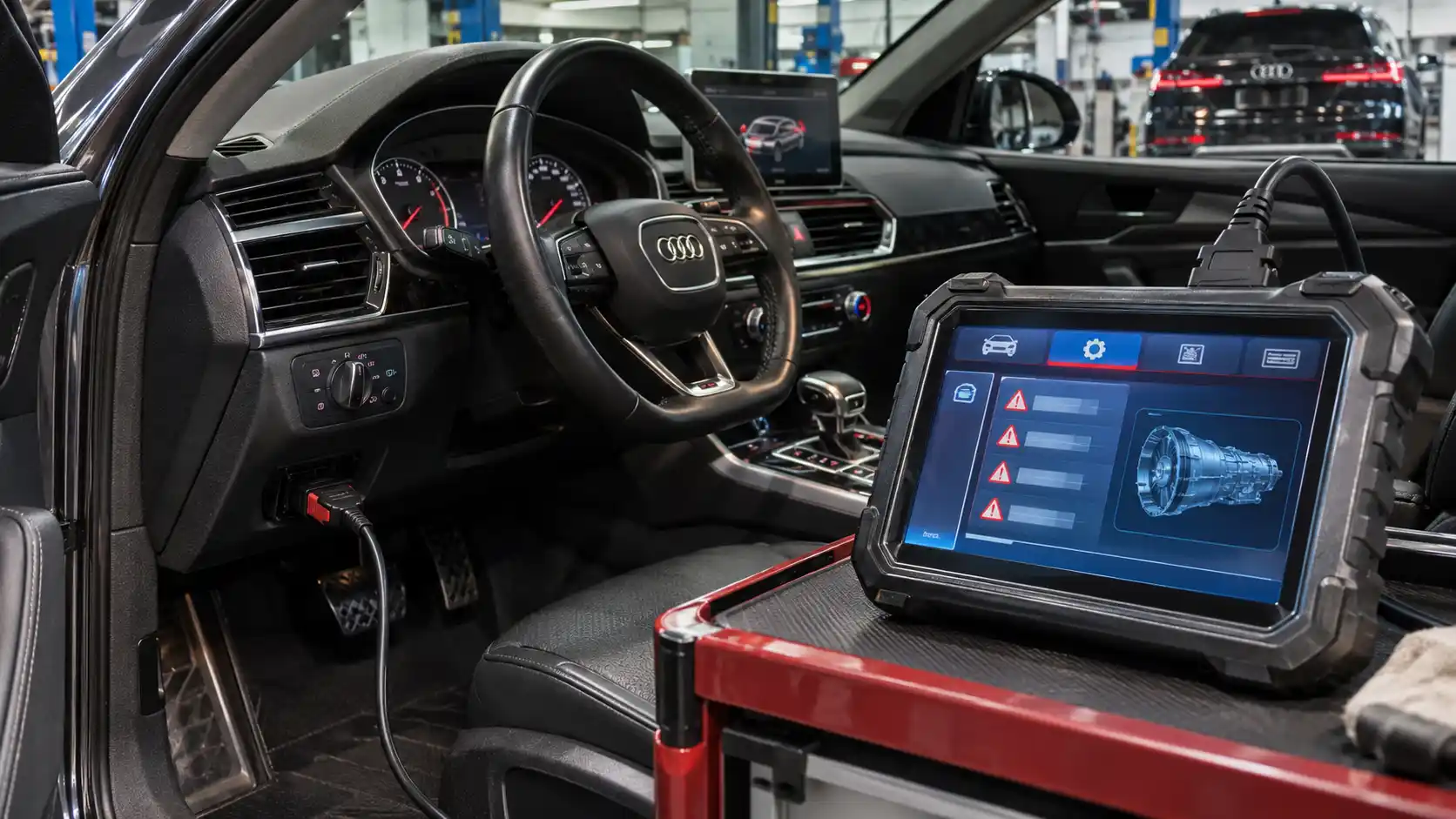
A flashing gear display or a "gearbox malfunction" message is one of the most worrying sights for an Audi driver. Behind every one of those warnings sits a stored code that explains what the gearbox control unit saw.
Reading Audi transmission fault codes comes down to four steps: connecting a scan tool that can reach the gearbox control module, reading both generic and Audi-specific codes, checking the freeze frame and fault status, and matching the code to your gearbox type. The most common codes point to clutch temperature, hydraulic pressure, solenoid valves, speed sensors and low voltage. The sections below explain each step, what the common codes mean and when a code calls for urgent repair.
Audi Gearbox Codes by the Numbers
Every standard trouble code has five characters, and the third character tells you which system raised it. A "7" in that spot, as in P0730 or P17BF, points straight to the transmission.
Audi takes codes seriously enough that its own repair bulletins demand an exact match. One Audi service bulletin for the 7-speed S tronic warns that the fault code and its DFCC number must match exactly, or the repair steps should not be followed.
Getting the reading right also protects your wallet. In Abu Dhabi, a TCM repair or replacement typically costs AED 2,300 to AED 4,500, a mechatronic unit AED 3,500 to AED 6,000, and a full rebuild AED 4,500 to AED 22,000 or more.
How an Audi Fault Code Is Built
Generic Codes vs Audi-Specific Codes
The first letter shows the area of the car, and "P" means powertrain. The second character tells you who defined the code: a "0" is a generic code shared by all brands, while a "1" marks a code Audi created for its own systems.
Generic codes such as P0700 or P0730 give a broad picture. Audi-specific codes such as P17D8 or P189C are far more precise, naming the exact clutch, valve or pump involved.
DFCC Numbers and Fault Status
Audi's diagnostic systems add a DFCC, a 4 to 6 digit number that sits beside the main code. It narrows down the exact fault condition, which is why Audi bulletins use it to choose the correct repair.
Each code also has a status. A "static" code is present right now, while a "sporadic" or intermittent code happened earlier and may come back, which changes how urgently it needs attention.
Tools That Can Read Audi Transmission Codes
A cheap OBD-II reader plugs into the same port as a dealer tool, but it usually talks only to the engine module. It may show a generic P0700 flag without the gearbox details behind it.
To see the full picture, the tool must reach the transmission control module, which Audi software lists under address 02. Tools such as VCDS, Audi's own ODIS and higher-end scanners like Autel MaxiSYS can read these codes, live data and adaptation values.
Some repairs also need the tool to run basic settings afterwards. The S tronic reference for the 0B5 gearbox notes that fault codes should be checked and cleared, then rechecked after a test drive.
Step-by-Step Guide to Reading the Codes
Connect and Scan Every Module
Park the car, switch the ignition on and connect the scan tool to the port under the dashboard. Run a full scan of all modules rather than the gearbox alone.
Gearbox faults often start somewhere else. A low battery, an engine speed sensor fault or a wheel speed error can all trigger transmission warnings, so the full scan shows the true starting point.
Record the Freeze Frame Data
Freeze frame data is a snapshot of conditions at the moment the fault was stored. It includes gearbox oil temperature, vehicle speed, engine speed and selected gear.
Write this down or save it before clearing anything. A clutch temperature code stored at 45 km/h in heavy traffic tells a very different story from one stored on an open highway.
Check How Often the Fault Appears
Most tools show a frequency counter and the mileage when the fault was first and last seen. A code that has appeared 50 times is clearly a lasting problem, not a one-off glitch.
Compare this with the driver's description of symptoms. Matching the code, the counter and the symptoms is what turns a code into a diagnosis.
Match the Code to Your Gearbox
The same code can mean different things on a dry-clutch DQ200, a wet-clutch DL501 or a ZF 8-speed Tiptronic. Checking the gearbox type first prevents the wrong repair.
The gearbox code is printed on the vehicle data sticker in the service book and the spare wheel well. A full scan also displays the gearbox and mechatronic part numbers.
Common Audi Transmission Codes and What They Mean
| Code | Meaning | Gearbox most often affected | How urgent |
|---|---|---|---|
| P0700 | Transmission control system fault flag | All automatic types | Read gearbox module next |
| P0715 | Input or turbine speed sensor circuit | Tiptronic and S tronic | Book soon |
| P0730 | Incorrect gear ratio, often slipping | All automatic types | Urgent |
| P0750 | Shift solenoid A fault | ZF Tiptronic (valve body) | Urgent |
| P0841 | Fluid pressure sensor implausible signal | DQ200 S tronic | Urgent |
| P0562 | System voltage low | All types | Test battery first |
| P1740 | Clutch temperature monitoring | DL501 S tronic | Urgent |
| P17D8 | Torque limited due to clutch temperature | DL501 S tronic | Urgent |
| P174A | Valve 3 in sub-gearbox 1, electrical fault | DL501 S tronic | Urgent |
| P17BF | Hydraulic pump protection limit reached | DQ200 S tronic | Stop and inspect |
| P189C | Function limited by low pressure build-up | DQ200 S tronic | Stop and inspect |
Clutch Temperature Codes
Codes such as P1740 and P17D8 appear when the gearbox computer sees its clutches running too hot. The car then limits engine power to protect itself.
On the DL501 S tronic used in models like the A4, A5, A6 and Q5, Audi bulletins link these codes to mechatronic faults. Long crawls in traffic and holding the car on a hill with the throttle make overheating worse.
Hydraulic Pressure Codes on the DQ200
The 7-speed dry-clutch DQ200 in smaller Audis such as the A1 and A3 is known for P17BF and P189C. Both point to the mechatronic unit failing to build or hold hydraulic pressure.
Symptoms include harsh shifts, dropping out of gear and a car that will not select drive. Driving on with these codes can damage the clutch, so the car should be inspected quickly.
Solenoid, Sensor and Voltage Codes
Solenoid codes like P0750 or P174A mean a valve that controls gear changes is not responding as expected. On a ZF Tiptronic, this often traces back to the valve body, and on an S tronic, to the mechatronic unit.
Sensor codes such as P0715 and voltage codes like P0562 are sometimes simpler fixes. A weak battery can trigger several gearbox codes at once, so it should always be tested before major parts are replaced.
Why Clearing Codes Without a Fix Backfires
Clearing a code switches off the warning light, but it does not repair anything. If the fault is still present, the code returns within a few drives, often with the car back in limp mode.
Clearing also wipes the freeze frame and frequency data a technician needs. That turns a quick diagnosis into guesswork and can lead to replacing the wrong part.
The better approach is to save the report, fix the cause and only then clear the codes. A road test afterwards confirms the fault has not come back.
When a Code Means Stop Driving
Some warnings can wait a few days, while others should not. A flashing gear display, a red gearbox warning, no drive engagement or a burning smell all mean the car should be parked and checked.
Limp mode, where the car stays in one gear with reduced power, is designed to get you off the road safely. It is not a mode for normal driving, even for short trips.
Codes that come with slipping, flare between gears or a jerk when shifting need prompt attention. Low fluid can also cause several of these codes, which is why fluid level is checked during every diagnosis.
Conclusion
An Audi gearbox code is not a verdict, but it is a strong clue. Read correctly, it points straight to the part that needs attention and saves money on guesswork.
Reading Audi transmission fault codes means using a tool that reaches the gearbox module, checking both generic and Audi-specific codes, and saving freeze frame and frequency data. Clutch temperature, hydraulic pressure, solenoid, sensor, and voltage codes are the most common groups. Matching each code to the exact gearbox type is the step that leads to the right repair.
Zenfo Auto Services in Musaffah M9 reads Audi gearbox codes with VCDS and Autel MaxiSYS tools and offers same-day transmission diagnostics. Book a diagnostic and get a clear repair plan before any parts are replaced.
Frequently Asked Questions
A basic scanner usually shows only generic codes like P0700 from the engine module. To see Audi-specific gearbox codes, the tool must reach the transmission module, which VCDS, ODIS, and advanced scanners can do.
P0700 is a general flag that tells you the transmission module has stored its own fault. The real cause sits in the gearbox module's codes, so a deeper scan is the next step.
It depends on the code and how the car behaves. If the car is in limp mode, slipping or not engaging drive, it should be parked and inspected to avoid further damage.
S tronic clutches slip slightly at crawling speeds, which builds heat in long queues. Codes like P1740 or P17D8 can also point to a mechatronic fault, so repeated codes need a proper check.
No, clearing only hides the warning until the fault returns. It also deletes the data a technician needs, so codes should be saved and the cause fixed first.