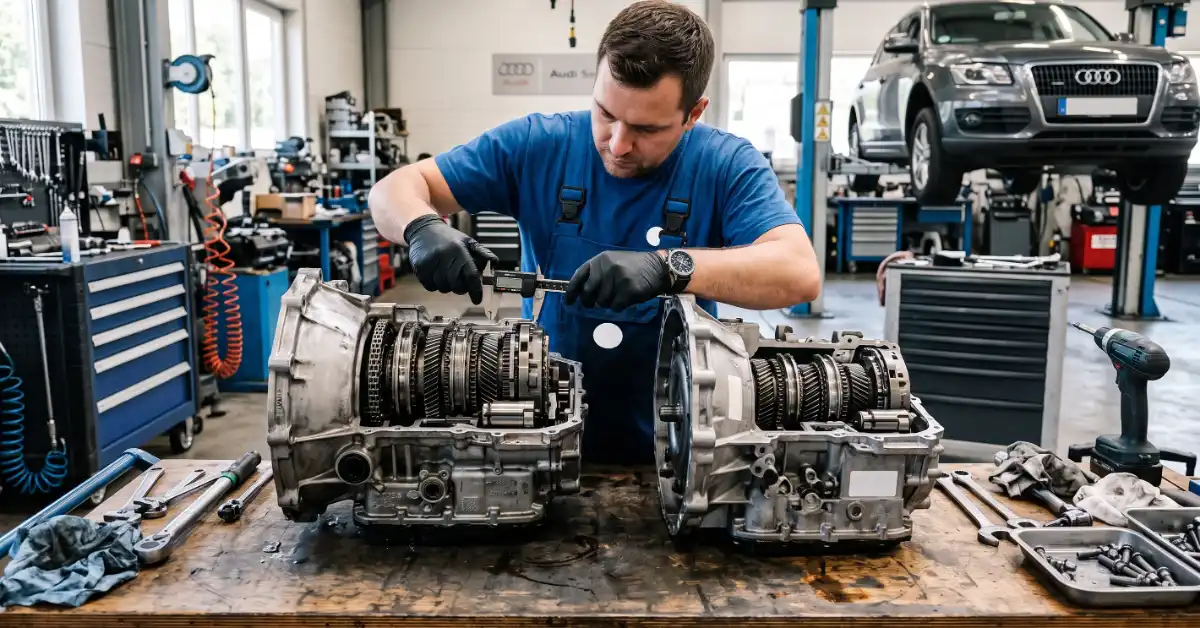
Choosing the right transmission parts can affect how smoothly an Audi shifts and how long its gearbox lasts. This is especially important in the UAE, where high summer temperatures and heavy traffic can place extra stress on transmission components.
Genuine Audi parts offer the safest fit and compatibility, while high-quality OEM parts can provide similar performance at a lower cost. Aftermarket parts are often cheaper, but their quality can vary widely.
For important gearbox components, choosing a trusted part is more important than simply choosing the lowest price.
Genuine, OEM, and Aftermarket Audi Parts
Audi transmission parts generally fall into three main groups: genuine, OEM, and aftermarket. Genuine parts are sold under the Audi name and are made to meet the vehicle manufacturer's specifications.
OEM parts are made by suppliers that produce components for vehicle manufacturers and are sold under the supplier's own brand. Aftermarket parts are made by independent companies and can range from high-quality replacements to low-cost copies.
This means the word aftermarket does not always mean poor quality. The manufacturer, material quality, testing, warranty, and correct fitment all matter when choosing a replacement.
1. Genuine Audi Transmission Parts
Genuine Audi parts are designed specifically for Audi vehicles and are supplied through official channels or approved parts suppliers. They are built to match the required dimensions, materials, and operating specifications of the original component.
This can be especially useful for complex parts such as mechatronic units, valve bodies, transmission control modules, sensors, and internal gearbox components.
Correct compatibility is important because modern Audi transmissions depend on electronic controls and precise hydraulic pressure. Genuine parts usually cost more, but they provide strong confidence in fitment and compatibility.
Main Benefits of Genuine Parts
- Exact Fit: Designed to match the original Audi transmission and vehicle specifications.
- Reliable Compatibility: Made to work with the vehicle's electronic and mechanical systems.
- Consistent Quality: Manufactured to defined quality and testing standards.
- Warranty Support: May provide stronger warranty coverage through official suppliers.
- Lower Fitment Risk: Reduces the chance of incorrect sizing or connector problems.
2. OEM Audi Transmission Parts
OEM stands for Original Equipment Manufacturer. These parts are made by companies that supply components to vehicle manufacturers or produce parts to the same factory-level specifications.
A quality OEM part can be a useful alternative to an Audi-branded part. It may cost less while still offering a high level of quality. However, it is important to confirm that the part is actually from the correct manufacturer and matches the required Audi transmission application.
3. Aftermarket Audi Transmission Parts
Aftermarket parts are made by companies that are not the original vehicle manufacturer or its direct factory supplier. The quality of these parts can vary more than genuine or established OEM options.
A reputable aftermarket manufacturer may produce a reliable replacement, while a very cheap part may use lower-grade materials or have poor quality control.
This can be a concern for transmission parts because small differences in sensors, seals, clutch components, or hydraulic parts can affect gearbox operation. Price should therefore not be the only factor when choosing an aftermarket transmission component.
Genuine vs OEM vs Aftermarket Parts: Side-By-Side Comparison
The three categories have different strengths and price levels. Genuine parts offer the most direct match to Audi specifications, while quality OEM parts can provide a good balance between cost and performance. Aftermarket parts offer the widest range of prices and quality.
| Feature | Genuine Audi | OEM | Aftermarket |
|---|---|---|---|
| Branding | Audi branded | Supplier branded | Third-party branded |
| Fitment | Designed for exact Audi application | Usually factory-level fit | Depends on manufacturer |
| Quality | Consistent | Usually high from trusted suppliers | Can vary widely |
| Price | Highest | Often lower than genuine | Usually lowest |
| Warranty | Usually strong | Depends on supplier | Depends on brand or seller |
| Best Use | Critical gearbox components | Quality replacement parts | Selected non-critical or performance parts |
Which Parts Should Use Genuine or OEM Quality?
Not every transmission component should be treated the same way. Critical parts that directly control gearbox operation deserve more attention than simple external hardware. Choosing poor-quality components can also increase the risk of Audi transmission problems, especially when the part does not work correctly with the vehicle's electronic or hydraulic systems.
For example, mechatronic units, solenoids, speed sensors, valve bodies, clutch packs, and transmission control components should come from genuine Audi or trusted OEM sources whenever possible. These parts work closely with the gearbox's electronic and hydraulic systems.
Using a low-quality component in a critical area can lead to incorrect readings, poor hydraulic control, rough shifting, or repeated faults. Saving money on the initial part may not be worthwhile if the vehicle needs to be repaired again.
Where Aftermarket Parts Can Make Sense
Good aftermarket parts can have a place in Audi transmission repairs when the component is not highly sensitive or when a reputable manufacturer has a strong record for that specific application.
External brackets, certain mounts, upgraded transmission coolers, and selected seals or hardware may be suitable examples, depending on the vehicle and repair. Performance-focused owners may also choose aftermarket cooling or clutch components for modified vehicles.
The key is to check the manufacturer's reputation, technical specifications, warranty, and compatibility. A trusted aftermarket part can offer good value, but an unknown low-cost part can create more risk.
How Does UAE Heat Affect Transmission Parts?
The UAE climate makes heat management an important part of transmission maintenance. Summer temperatures can rise above 45°C, while slow traffic can keep the gearbox working under high thermal load for long periods.
Transmission fluid, seals, wiring, sensors, and clutch components must all operate correctly under these conditions. Poor-quality materials may not provide the same level of durability as parts designed and tested for demanding use.
This does not mean every aftermarket part will fail in UAE conditions. It means buyers should pay close attention to the quality and technical rating of the component.
Heat is what decides this question locally. A marginal part that would survive in a temperate climate is working near its limit in an Abu Dhabi summer, and the components that fail first are the seals and the electronics inside the mechatronic unit, which are also the most expensive to reach.
How to Choose the Right Transmission Part?
The correct part should always be selected according to the exact Audi model, production year, engine, and transmission code. Two Audi models that look similar may use different gearboxes or different versions of the same transmission.
Before ordering a part, provide the supplier with the vehicle's 17-digit VIN. The VIN can help confirm the correct application and reduce the chance of receiving an incompatible component.
It is also useful to compare the original part number, gearbox code, supplier information, warranty terms, and technical specifications before making a purchase.
What a repair involves covers where in the process the part choice is actually made, which is usually after the strip-down rather than before it.
How to Avoid Poor-Quality Transmission Parts?
Very cheap transmission parts can be tempting when repair costs are high, but the initial saving may disappear if the component fails early. Counterfeit or poorly made parts may also look similar to genuine products, making careful sourcing important.
Check the packaging, part number, supplier reputation, warranty, and manufacturer details before buying. For fluids, always confirm the exact specification required by the transmission. Do not select a fluid simply because it is described as suitable for Audi.
A reliable workshop or parts supplier can also verify the component against the vehicle's VIN and transmission code before installation.
Genuine vs Aftermarket Parts: Which Is Better?
There is no single answer for every Audi transmission repair. Genuine Audi parts are the safest choice when exact compatibility, warranty support, and factory specifications are the main priorities. Quality OEM parts can offer a strong alternative when the original supplier is known and the correct part number is confirmed.
Aftermarket parts can reduce repair costs, but they require more careful selection. For critical transmission electronics and internal components, genuine or trusted OEM parts are usually the safer choice. For less critical components, a well-known aftermarket brand may provide good value without affecting normal gearbox operation.
Part choice moves the total more than most owners expect, since it lands on top of the labour rather than instead of it. Local repair pricing shows the ranges those choices sit inside.
Final Thoughts
The choice between genuine, OEM, and aftermarket transmission parts can have a direct effect on Audi gearbox reliability. Genuine Audi parts offer exact fitment and strong compatibility, while quality OEM parts can provide similar factory-level performance at a lower cost.
Aftermarket parts can also be useful, but their quality varies between manufacturers. For important components such as mechatronics, sensors, solenoids, valve bodies, and clutch parts, avoid unknown low-cost options.
Always confirm the correct part using your Audi's VIN and transmission code. For professional Audi transmission inspection, parts replacement, and maintenance in the UAE, contact Zenfo Auto Services for reliable service and support.
The safest route is to let the workshop source the parts against the VIN. An Audi workshop that sources OEM parts removes both the specification risk and the fitting risk in one step.