
An Audi with a transmission problem is one of the more stressful things to own, mostly because the range of possible outcomes is so wide. Slipping gears, unfamiliar noises or a refusal to shift properly could mean a fluid service or a rebuild, and from the driver's seat they feel identical.
This is what a proper repair actually involves: the sequence a competent workshop follows, why each step exists, and where the line falls between what an owner can reasonably do and what needs a technician. It applies whether the car is an A4, A6, Q5 or anything else in the range.
How a Professional Repair Runs
Transmission work is not parts replacement. A skilled technician follows a defined sequence specifically to find the root cause rather than the most visible symptom.
Step 1: Full diagnostic scan. The car goes on a diagnostic tool first, reading the fault codes stored in its control modules. Those codes point to where the problem started. Without this step a mechanic is guessing, and guessing on an Audi gearbox is expensive. Audi-specific tools such as VCDS or ODIS are what read this properly; a generic OBD reader will not access the transmission modules in useful detail.
Step 2: Physical inspection. After the scan comes the hands-on work: fluid level and condition, leaks around the gearbox, and a test drive listening for anything the codes did not capture. This confirms what the scan found and catches issues that never generated a code.
Step 3: Fluid change or flush. In many cases this is the first and only repair needed. The old fluid is drained and replaced with the correct Audi-approved specification. Where the fluid is heavily contaminated, a full flush clears the sludge and metal particles that have accumulated. Shift quality often improves immediately.
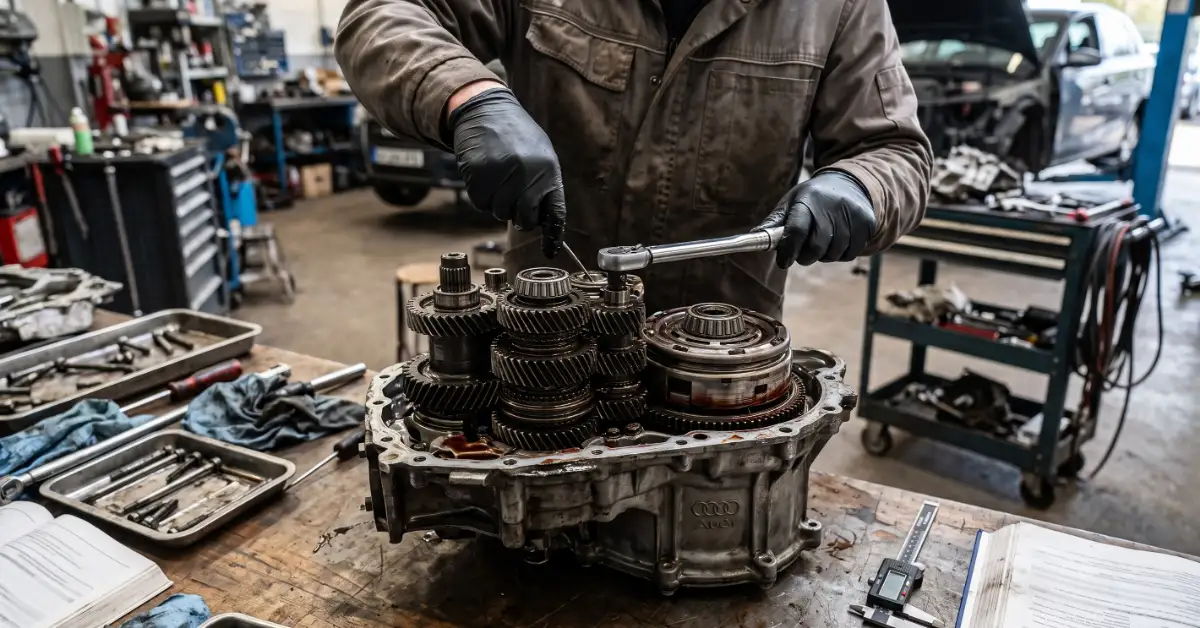
Step 4: Part replacement or rebuild. If the problem is beyond fluid, the transmission comes out for closer inspection. Worn solenoids, damaged clutch packs, a faulty valve body or a failing torque converter are replaced as required. In severe cases a full rebuild follows, with every internal part inspected, cleaned and replaced where worn. Only parts meeting Audi standards should be used. This is not the place for a cost saving.
Step 5: Software update and recalibration. Once the mechanical work is done, the transmission control unit software is updated where applicable and the gearbox recalibrated so it shifts in harmony with the engine. On an Audi this step is genuinely important rather than a formality: the engine and transmission are coordinated through the vehicle's control network, and a mechanically perfect gearbox with stale adaptation values still shifts badly.
Step 6: Test drive and quality check. No repair is finished without driving the car under varied conditions to confirm every gear engages correctly, no warning lights return, and the transmission feels right. The owner should get a report of what was done alongside the car.
Why the Diagnosis Matters More Than the Repair
The cost spread across those steps is enormous. A fluid service and a gearbox rebuild sit at opposite ends of a range that can differ by more than tenfold, and the symptoms that lead to each overlap almost completely.
That is the whole argument for step one. An hour spent scanning and inspecting properly is what determines whether the car needs a service or surgery, and it is the cheapest hour in the process. What it costs to put right sets out how those figures compare.
It also matters more on cars driven here than elsewhere. Sustained heat and the stop-start running typical of journeys through Musaffah and the surrounding industrial districts age transmission fluid faster than distance alone suggests, so a fault that looks like mechanical wear at 80,000 km is often fluid degradation that arrived early. Establishing which one you have before parts are ordered is what controls the bill.
DIY Versus Professional Repair
Some jobs are entirely reasonable to do yourself. Checking the fluid level, topping it up, and looking for leaks are all within reach of an owner with basic tools.
Opening the gearbox, replacing internal components, or running a software update is not. Audi transmissions are complex systems where a small mistake converts a minor issue into a full replacement, and the sealed designs on newer cars require the fluid level to be set at a specified temperature with diagnostic equipment attached, which rules out the driveway entirely.
For anything beyond basic checks, a trained technician is the cheaper option even when the labour looks more expensive.
Keeping the Gearbox Out of the Workshop
Good maintenance prevents most gearbox problems outright:
- Change the fluid regularly. Follow Audi's service intervals, and shorten them for the conditions here rather than taking the published figure at face value
- Avoid overloading. Heavy loads put real stress on the transmission
- Let the car warm up. A minute or two before driving hard lets the fluid circulate
- Use the right fluid. The specification for your specific model, not a universal product
- Address small problems early. Every expensive repair in this guide started as a cheap one
If you would rather start from first principles, the basics of the system explains what each component does and why it fails.
Getting Yours Looked At
Ignoring rough shifting or a fluid leak is how a manageable repair becomes a gearbox replacement. Regular fluid changes, timely part replacement and proper diagnostics keep a transmission running for years.
If your car is showing any of the symptoms in this guide, Audi transmission repair in Abu Dhabi starts with the same six-step process described above: scan first, then inspect, then repair what the evidence actually points to.