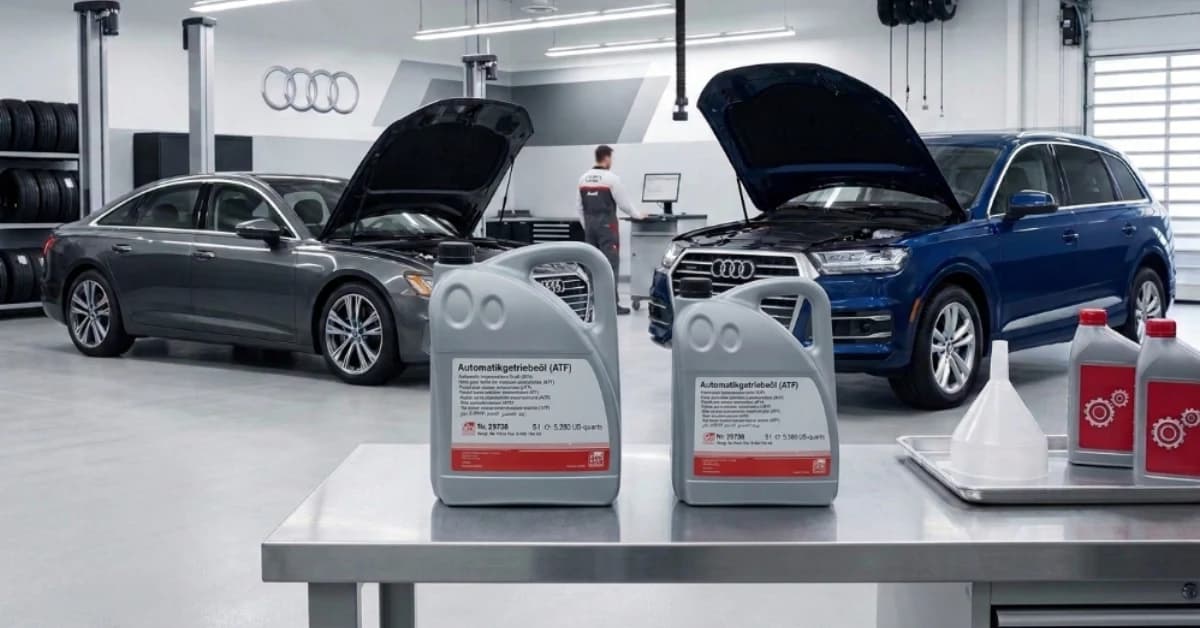
Most Audi owners know their engine oil capacity and almost none know the gearbox figure. It matters for the same reason: an underfilled transmission loses hydraulic pressure, and an overfilled one aerates the fluid so it cannot carry heat properly.
Capacity varies by model, gearbox and production year. Most Audi automatics hold between 6 and 10 litres for a complete service, and larger SUVs take more. The figures below are the working numbers, along with why the interval matters more here than the mileage does.
What the Fluid Is Doing
Inside the gearbox the fluid lubricates moving parts, reduces friction, controls heat and transfers the hydraulic pressure that changes gear. Modern Audi transmissions depend on all four functions simultaneously.
When the fluid is dirty or the level drops, drivers notice rough shifting, delayed engagement, unusual noises and higher operating temperatures, usually in that order. What the fluid does in normal operation explains why the failure sequence is so consistent.
Capacity by Model
Two figures matter, and they are not the same. A drain and refill replaces only part of the fluid; a complete service replaces what is held throughout the system and therefore takes more.
| Model | Transmission | Approximate capacity |
|---|---|---|
| Audi A3 | S tronic | 5.5 – 7 litres |
| Audi A4 | Tiptronic / S tronic | 6 – 9 litres |
| Audi A6 | Tiptronic / ZF automatic | 7 – 10 litres |
| Audi Q5 | S tronic / Tiptronic | 7 – 9 litres |
| Audi Q7 | ZF 8-speed automatic | 9 – 12 litres |
Treat these as planning figures. The exact volume for a specific car comes from the transmission code, not the model badge.
Audi A6
The A6 has been offered with several gearbox options, so capacity ranges from roughly 7 to 10 litres depending on engine and transmission configuration.
Newer cars generally use ZF automatics requiring fluid that meets Audi's specification. That precision is not optional. These gearboxes rely on exact hydraulic pressure and friction characteristics, and incorrect fluid affects shift quality before it causes wear. The A6 fluid reference goes model-year by model-year.
Audi Q7
The Q7 carries a heavier drivetrain and greater towing capability, so it typically holds between 9 and 12 litres for a complete service. Most use the ZF 8-speed, which is smooth and durable but still dependent on maintenance.
A large SUV generates significant heat, and in Abu Dhabi that is the deciding factor. Heavy loads, stop-and-go running, high ambient temperatures and towing all stack onto the same fluid. Q7 owners here should treat the shorter interval as the real one rather than the published maximum, and the Q7 fluid procedure covers the service in detail.
A4, A5 and the Rest of the Range
Smaller sedans and coupés need less fluid than the SUVs. The A4 and A5 commonly use S tronic dual-clutch or Tiptronic units depending on year and engine.
These transmissions are built for quick, efficient changes and contain sophisticated electronic and hydraulic systems, which is precisely why the level has to be right. Small deviations show up as changes in shift quality, economy and general refinement long before they cause damage.
How Often to Change It
Some Audi transmissions were sold as lifetime filled. Independent practice disagrees, and for good reason.
For most Audi vehicles, fluid service is commonly recommended between 50,000 and 80,000 km depending on conditions. Heavy traffic, extreme temperatures, towing and hard driving all argue for the shorter figure.
Every one of those factors describes normal driving here. Sustained ambient heat, congested runs across Musaffah and the surrounding industrial areas, and loaded vehicles are the local default rather than the exception, so 50,000 km is the sensible planning number, not 80,000. Service intervals covers how to judge it for a specific car.
What Low Fluid Causes
Because the fluid provides both lubrication and hydraulic pressure, running low escalates quickly:
- Slipping gears
- Delayed shifting
- Overheating components
- Increased internal friction
- Premature clutch wear
- Reduced fuel efficiency
A low level in a sealed system also means the fluid has gone somewhere. Topping up without finding the leak simply repeats the failure on a longer timescale.
Why Filling Is a Workshop Job
Modern Audi transmissions are checked and filled at a specific fluid temperature, measured with diagnostic equipment, because ATF expands as it warms. A level set at the wrong temperature is wrong even if the volume looks correct.
That is the practical reason this is not a driveway job on most cars. The procedure needs the right tooling, the correct approved fluid, a filter where one is fitted, and a verification pass afterwards. Booking a measured drain and refill gets the volume and the temperature right together.
Selecting the fluid needs the same care. Technicians should confirm the model and year, the transmission type, the OEM specification, any service bulletin updates and the transmission code before anything is opened, which is why it is worth using a workshop with the ATF fill equipment and the platform knowledge rather than a general garage.
What Shortens Fluid Life Locally
Fluid does not age at the same rate in every car. The factors that accelerate it are:
- High ambient temperatures
- Frequent traffic congestion
- Heavy towing loads
- Aggressive acceleration
- Extended idling
- Poor cooling system performance
The first two are simply a description of driving in Abu Dhabi, and the others are common enough locally to matter. Build the service schedule around how the car is actually used rather than around a figure written for a different climate, and the capacity table above becomes a maintenance plan rather than a reference.