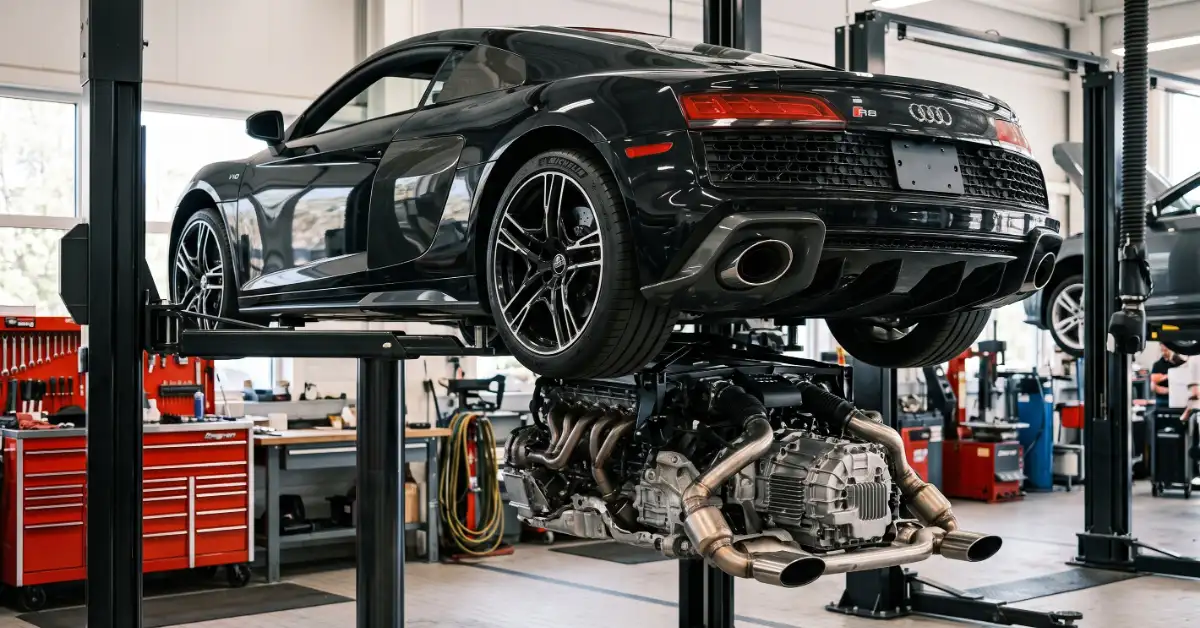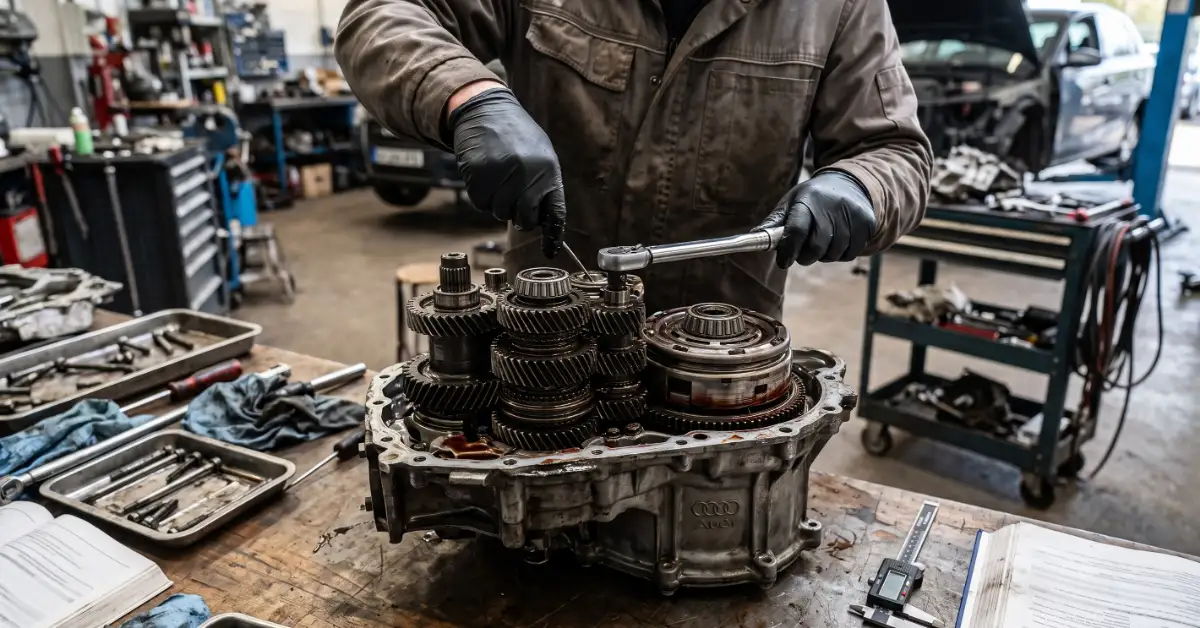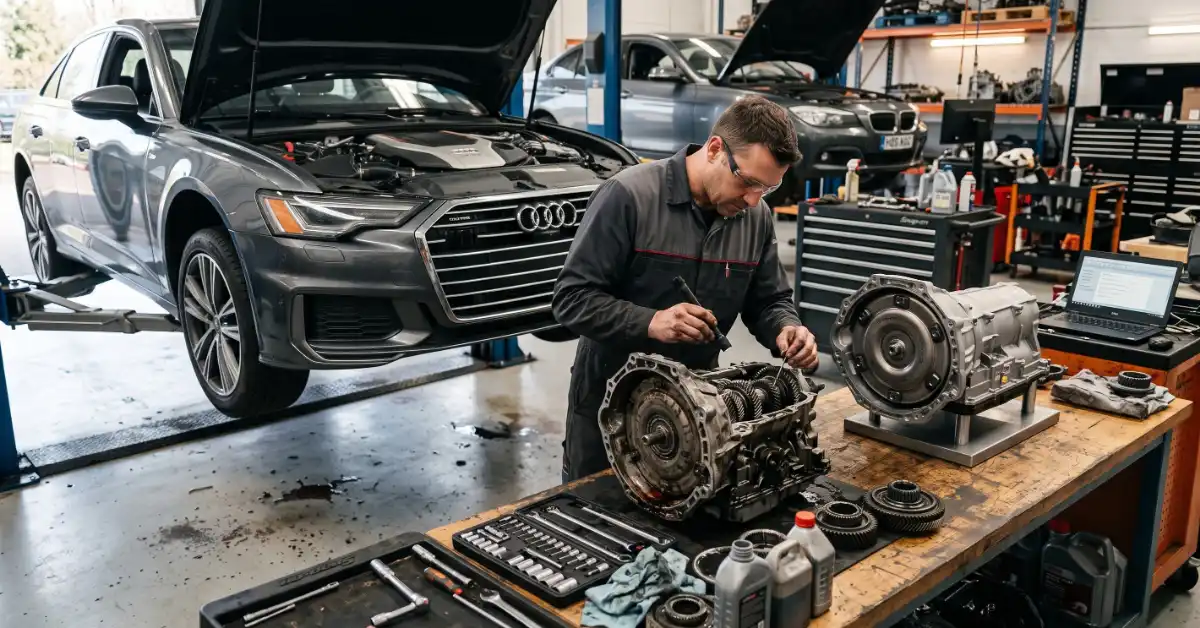
A transmission can change the way an Audi feels on the road. The right gearbox can make daily driving smoother, improve fuel use, and give you better control when you need quick acceleration.
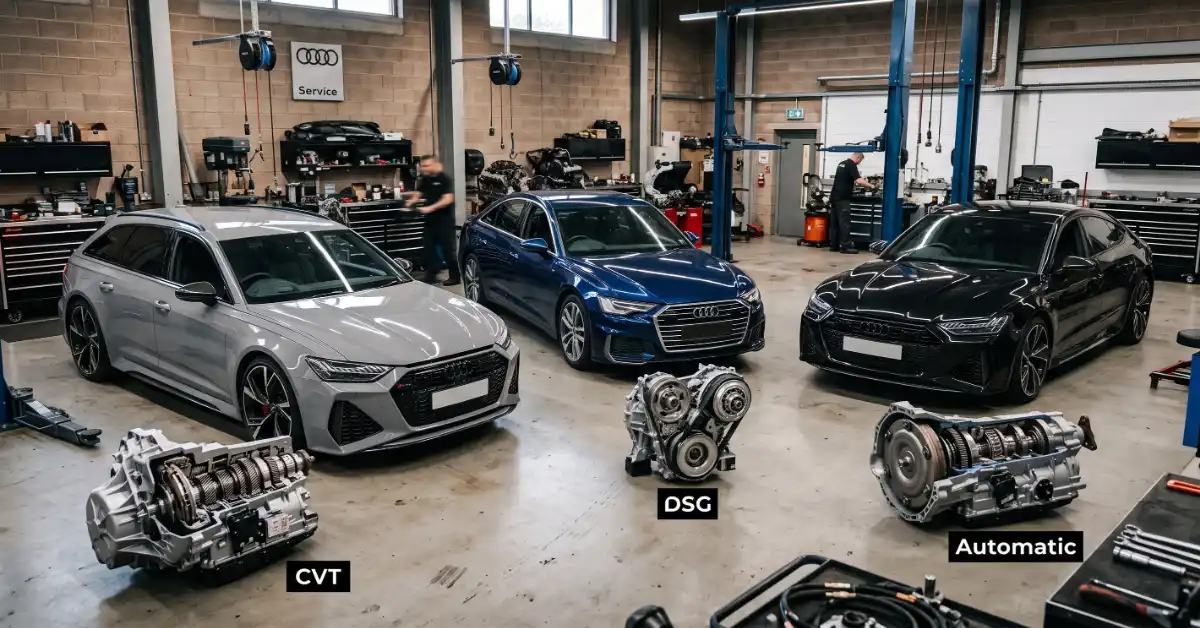
DSG vs CVT vs Automatic comes down to how each system transfers engine power and changes its gear ratio. A DSG or Audi S tronic uses two clutches to make very quick gear changes.
A traditional automatic, such as Tiptronic, uses a torque converter for smooth power delivery and strong low-speed performance. A CVT, known as Multitronic in older Audis, changes ratios continuously instead of using fixed gears.
For most Audi drivers, S tronic is the best choice for performance, while Tiptronic is better for comfort, durability, and high-torque driving.
Understanding Audi Transmission Types
Audi has used different automatic transmission designs, each offering a different balance of speed, comfort, efficiency, and driving response.
- S tronic: A dual-clutch transmission that delivers fast gear changes, strong acceleration, and a sporty driving experience for performance-focused Audi drivers.
- Tiptronic: A traditional automatic transmission using a torque converter, offering smooth shifts, strong torque handling, and comfortable everyday driving.
- Multitronic: An older continuously variable transmission that provides seamless acceleration and fuel efficiency, mainly used in older front-wheel-drive Audi models.
How Audi S tronic and DSG Work?
Audi S tronic is a dual-clutch transmission, often compared with Volkswagen's DSG system. Instead of one clutch, it uses two clutch packs. One controls odd-numbered gears, while the other controls even-numbered gears.
The transmission can pre-select the next gear before a shift is needed. This helps reduce shift time and keeps power flowing to the wheels. An electronic mechatronic unit controls the clutch operation and gear selection.
The result is a fast, direct driving feel that suits drivers who enjoy quick acceleration and manual control via paddle shifters.
Main Benefits of S tronic
S tronic is designed for drivers who want quick response, strong performance, and better control during everyday and spirited driving.
- Fast Gear Changes: Dual-clutch technology allows very quick gear changes, helping the Audi accelerate smoothly while keeping power delivery strong.
- Quick Throttle Response: The transmission reacts quickly when you press the accelerator, making the car feel more responsive during acceleration.
- Paddle Shifter Control: Drivers can change gears manually using paddle shifters without operating a traditional clutch pedal.
- Good Highway Efficiency: Higher gears can lower engine speed during highway driving, which may help improve fuel economy.
- Regular Maintenance Needed: Proper fluid service and inspections are important because neglected clutch or mechatronic problems can lead to costly repairs.
How Does Audi Tiptronic Work?
Tiptronic is a traditional automatic transmission that uses a torque converter and fixed gear ratios. The torque converter transfers engine power to the transmission through fluid, which allows the car to move away from a stop in a smooth way.
Modern Tiptronic gearboxes can have several forward gears and use electronic controls to select the correct ratio. They are commonly suited to larger Audi vehicles and engines that produce high torque.
The design is also well suited to heavy traffic, long-distance driving, and situations where smooth power delivery matters more than the fastest possible gear change.
Main Benefits of Tiptronic
Tiptronic is designed for smooth power delivery, comfortable driving, and reliable performance across city roads, highways, and demanding conditions.
- Smooth Power Delivery: The torque converter helps the Audi move gently from a stop, making traffic, parking, and slow driving easier.
- Strong Torque Handling: A well-maintained Tiptronic can handle high engine torque, making it suitable for larger Audi models and long trips.
- Comfortable City Driving: Smooth gear changes reduce sudden movements, providing a more relaxed experience during frequent stops and starts.
- Improved Shift Performance: Modern Tiptronic systems offer faster and more efficient gear changes than many older automatic transmissions.
- Balanced Performance: Although it feels less sporty than S tronic, Tiptronic combines comfort, strength, smoothness, and everyday usability effectively.
How Does Audi Multitronic CVT Work?
Multitronic was Audi's name for its continuously variable transmission, or CVT. Unlike a normal automatic, it does not use a set of fixed gears in the same way. It uses variable pulleys and a steel chain to change the transmission ratio.
This allows the engine to stay near an efficient operating speed during normal driving. Multitronic was mainly used in older front-wheel-drive Audi models, including some A4, A5, and A6 versions.
Audi later moved away from the system and replaced it with newer transmission technologies such as S tronic and Tiptronic.
Main Benefits and Drawbacks of Multitronic
Benefits of Multitronic- Seamless Power Delivery: Multitronic provides continuous acceleration without traditional gear shifts, creating a smooth and steady driving experience.
- Efficient Engine Operation: The transmission can keep engine speed within an efficient range, which may support better fuel economy.
- Smooth Low-Speed Driving: Its continuously changing ratio can make slow city driving and gentle acceleration feel smooth and consistent.
- Reduced Shift Shock: Since there are no normal fixed-gear changes, passengers do not feel the sudden shift movements common with traditional transmissions.
- Relaxed Highway Cruising: Multitronic can maintain a suitable ratio during steady highway driving, helping keep engine speed and cabin noise lower.
- CVT Drone: During hard acceleration, the engine may hold high RPM, creating a constant sound known as CVT drone.
- Reliability Concerns: Older Multitronic units can develop chain, pulley, internal component, or control system problems when maintenance is neglected.
- Higher Repair Costs: Serious internal wear can require expensive repairs, making a complete service history important when buying an older Audi.
DSG vs CVT vs Automatic: Key Differences
The three systems have different strengths, so there is no single answer for every driver. S tronic is focused on quick shifts and sporty response. Tiptronic places more focus on smoothness, torque handling, and relaxed driving. Multitronic focuses on continuous ratio changes and fuel efficiency but is now mainly relevant when buying an older used Audi. The table below gives a quick comparison.
| Feature | DSG / S tronic | Automatic / Tiptronic | CVT / Multitronic |
|---|---|---|---|
| Transmission type | Dual-clutch | Torque-converter automatic | Continuously variable |
| Main strength | Fast shifting and performance | Smoothness and durability | Fuel efficiency |
| Gear changes | Very quick | Smooth and controlled | No fixed gear changes |
| Low-speed driving | Can feel slightly jerky | Very smooth | Smooth but may drone |
| Paddle shifting | Excellent | Available on many models | Limited compared with geared systems |
| Quattro use | Available on many applications | Common on many applications | Generally associated with FWD models |
| High-torque use | Depends on gearbox version | Very good | Less suited to high-performance use |
| Maintenance | Requires correct fluid and service | Regular fluid service is important | Service history is very important |
| Driving feel | Sporty and direct | Smooth and refined | Seamless and relaxed |
| Best for | Performance-focused drivers | Daily use and long trips | Older fuel-focused models |
Which Audi Transmission Is Best for Performance?
S tronic is generally the strongest choice for drivers who care about acceleration and fast gear changes. Its dual-clutch design allows the next gear to be prepared before the shift takes place.
This helps reduce the time between gears and gives the car a more direct response. Paddle shifters can also make the driving experience more engaging. S tronic is especially attractive in sporty Audi models where quick response is important. It is not perfect, though.
Very slow traffic, tight parking movements, and repeated stop-and-go use can make some versions feel less smooth than a torque-converter automatic.
Which Audi Transmission Is Best for Comfort?
Tiptronic is usually the better option when comfort is the main goal. Its torque converter allows smooth movement from a stop and helps reduce the sharp clutch feel that can sometimes occur with a dual-clutch gearbox.
This is useful on busy city roads where the car repeatedly moves, stops, and starts. It also works well on long journeys because gear changes are generally calm and progressive.
Larger Audi models can benefit from this design because the transmission can handle high torque while keeping the driving experience refined. For a relaxed daily driver, Tiptronic is difficult to beat.
Which Transmission Is Best for Fuel Economy?
A CVT can be very efficient because it can keep the engine close to its most efficient operating range. Multitronic was designed around this idea and could provide smooth, steady acceleration without normal shift points.
S-tronic can also deliver good fuel economy because it changes gears quickly and can keep engine speed low during cruising. Tiptronic has improved greatly in this area as newer versions gained more gears and better electronic control.
Real-world fuel use still depends on the engine, vehicle weight, driving style, traffic, road conditions, and maintenance. Transmission type alone does not determine fuel consumption.
Transmission Maintenance and Repair Needs
Regular maintenance is important for every Audi transmission. S tronic units may require specific transmission fluid and filter service, depending on the gearbox model and service schedule.
Neglect can increase clutch and mechatronic wear. Tiptronic gearboxes also need the correct fluid and service at the recommended intervals, especially when the vehicle is used in heavy traffic or hot conditions.
Multitronic requires particular care because chain, pulley, valve body, and electronic problems can become expensive. Warning signs such as delayed engagement, slipping, shuddering, harsh shifts, unusual noises, or transmission warning messages should be checked before the problem becomes more serious.
Common Transmission Problems to Watch For
Different Audi gearboxes can develop different faults. Common problems include:
- S tronic: Clutch wear, mechatronic faults, overheating, and low-speed hesitation.
- Tiptronic: Fluid leaks, valve body problems, torque converter faults, and harsh shifting.
- Multitronic: Chain and pulley wear, electronic faults, and poor ratio control.
- Warning signs: Unusual noises, delayed engagement, rough shifts, slipping, or transmission warning lights.
- Diagnosis: A diagnostic scan and road test can help identify the source of the problem.
Whichever platform is fitted, the maintenance that matters is the same: correct specification fluid, changed early. Approved fluid specifications lists what each one takes.
Which Audi Gearbox Is Better for UAE Driving?
UAE driving conditions can be demanding because of high temperatures, heavy traffic, long highway journeys, and frequent stop-and-go driving. A well-maintained Tiptronic can be a strong option for drivers who want smooth performance in these conditions.
S-Tronic can also work very well, especially for drivers who prefer quick response, but correct fluid service and proper inspection are important. Older Multitronic models need more care when buying used because their age and service history can affect reliability.
Regardless of gearbox type, following the manufacturer's service requirements is important for protecting the transmission in a hot climate.
Abu Dhabi narrows the gap between these platforms in one specific way: heat. The congested runs through Musaffah and ICAD keep clutches and torque converters in their heat-generating phase without the sustained airflow a highway run provides, so the platform that tolerates that duty cycle best is usually the ZF automatic. The platform breakdown covers which unit is in which car.
DSG vs CVT vs Automatic: Which One Should You Choose?
The best choice depends on what you expect from your Audi. S tronic is the better option for quick shifts, strong response, and sporty driving. Tiptronic is a better match for smooth daily driving, larger vehicles, long trips, and high-torque applications.
Multitronic can provide smooth and efficient driving, but it is an older system that requires careful inspection and a strong service history.
For most buyers choosing between newer Audi options, S tronic and Tiptronic are more attractive choices than an older Multitronic. The transmission should always be matched to the vehicle, engine, and intended use.
Final Verdict
Audi's transmission choices are built around different driving needs rather than one design being perfect for everyone. S tronic gives you fast gear changes and a sporty feel, while
Tiptronic provides smooth operation, strong torque handling, and good everyday comfort. Multitronic offers seamless ratio changes but is mainly important when considering older used Audi models.
For performance, S tronic is the clear choice. For comfort, durability, and relaxed driving, Tiptronic is usually the better option. Multitronic can still work well when properly maintained, but its service history deserves close attention.
If your Audi is showing transmission warning lights, rough shifting, delayed engagement, or unusual gearbox behavior, Zenfo Auto Services can help with professional car inspection and Audi transmission repair services. Getting the problem checked early can help prevent a small transmission issue from becoming a major repair.
If you are choosing between two cars, or want the one you own assessed properly, the Audi workshop on M9 can tell you which unit you have and what condition it is in.