Almost every avoidable Audi gearbox failure traces back to one of two things: fluid that was left too long, or fluid that was the wrong specification. Both are cheap to get right and expensive to get wrong.
This is the reference for getting it right: the specification for each platform, the capacity by model size, and how to check a level on a sealed unit. It matters more in Abu Dhabi than in most markets, because heat narrows the margin for error on all of it.
Why the Fluid Carries So Much of the Load
Transmission fluid is not simply a lubricant. In an Audi it is also the hydraulic medium that applies the clutches and the coolant that carries heat out of the gearbox.
Modern units, S tronic in particular, run at high pressure and high temperature, which makes fluid quality decisive rather than incidental. Old or incorrect fluid produces slipping, overheating and delayed shifting, and it does so long before anything mechanical has actually broken. That is why each platform has its own approved specification rather than a shared one.
Fluid Type by Gearbox Platform
S tronic / DSG (dual clutch). Specification VW G 052 182 A2 for 6-speed units, or VW G 055 529 A2 for 7-speed. Used across most four-cylinder S tronic cars including the A3, A4, S3 and Q3. Dual-clutch systems need fluid formulated for high pressure and rapid engagement; the approved specification is what keeps clutch operation and heat control within design limits.
Tiptronic (torque-converter automatic). Specification Audi G 060 162 A2, or ZF Lifeguard 8 on 8-speed units. Common on larger and performance models such as the S4, Q7, Q8 and RS6. The fluid supports hydraulic pressure, cooling and torque transfer, and the right choice is what keeps acceleration smooth and temperatures controlled under load.
Multitronic (CVT). Specification Audi G 052 180 A2. Found in older front-wheel-drive models. The CVT depends on this fluid to maintain belt tension; the wrong product causes slipping, vibration and early wear, and on this platform that damage is rarely economic to repair.
Manual gearboxes and differentials. Specification VW G 052 911 A2, or GL-4 / GL-5 75W-90 gear oil. Manual units use gear oil rather than ATF, protecting gears from wear and supporting load distribution through the drivetrain.
What the Specifications Actually Control
Those G-numbers are not branding. Each defines a set of properties the gearbox was designed around.
- Viscosity. Too thick or too thin and you get delayed shifting, slipping or rough engagement. The specification holds the flow behaviour across both cold starts and sustained heat.
- Thermal stability. The fluid has to resist breaking down at temperature. This is the property that matters most locally, because poor thermal stability turns into oxidation, then into wear.
- Friction characteristics. Dual-clutch units depend on precisely controlled slip during engagement. Get this wrong and you get shudder, jerky shifts and early clutch wear.
- Anti-wear additives. These protect gears, bearings and clutch components from metal-to-metal contact.
- Seal compatibility. Incorrect fluid can swell, shrink or crack internal seals, which turns a fluid problem into a leak.
- Oxidation resistance. Determines how long the fluid holds its properties before sludge forms and lubrication drops off.
If you want the practical version of which product to buy, the fluid selection guide works through it by model.
Capacity by Model Size
Quantity matters as much as specification: an underfilled gearbox loses hydraulic pressure, an overfilled one aerates the fluid.
- Smaller sedans: roughly 5 to 7 litres for a full service, varying with whether the job is a partial drain or a complete flush.
- Mid-size models and SUVs: approximately 7 to 9 litres. Larger, more complex units carrying more weight need the extra volume for cooling and hydraulic balance.
- S and RS performance models: often 8 to 10 litres or more. These run higher pressures and faster shifts, and the capacity supports heat stability under sustained load.
Model-by-model capacities go further if you need the figure for a specific car.
How to Check the Level on a Modern Audi
Most current Audi transmissions are sealed or electronically monitored, so there is no dipstick and no casual check.
Diagnostic tooling. The level can only be measured accurately at a defined fluid temperature, because ATF expands as it warms. A scan tool confirms the gearbox is in that window before the level is set. Without it, readings are guesswork and the result is over- or underfilling.
Workshop procedure. Checking to the manufacturer's method needs the right equipment and a technician who knows the platform. This is the difference between a level that is correct and one that merely looks correct.
Condition assessment. While the level is being set, the fluid itself gets inspected. Healthy fluid is red or light pink and flows cleanly. Dark, thick or burnt-smelling fluid indicates overheating or internal wear, an early warning worth acting on. Because the temperature window is the part most often skipped, it is worth having have the specification confirmed before refilling rather than trusting a generic service.
Signs the Wrong Fluid Went In
If problems appear shortly after a service, incompatible fluid is a leading suspect.
- Harsh gear changes that were not there before
- Delayed engagement into Drive or Reverse, from reduced hydraulic pressure
- Grinding or whining from inadequate lubrication
- Higher operating temperatures, because the fluid cannot carry heat as designed
- Worse fuel economy, from increased internal resistance
The correct response is not to wait and see. Draining and refilling with the approved specification early costs far less than replacing clutch packs damaged by the wrong friction characteristics.
Keeping It Right in Abu Dhabi Conditions
Everything above is standard practice. What is specific to driving here is how much less margin the heat leaves.
Sustained high ambient temperatures mean the fluid begins its working life near the top of its thermal range. Short, stop-start journeys around Musaffah and the neighbouring industrial areas keep clutches and torque converters in their heat-generating phase without the airflow of a longer run. Both push oxidation along faster than the published interval assumes.
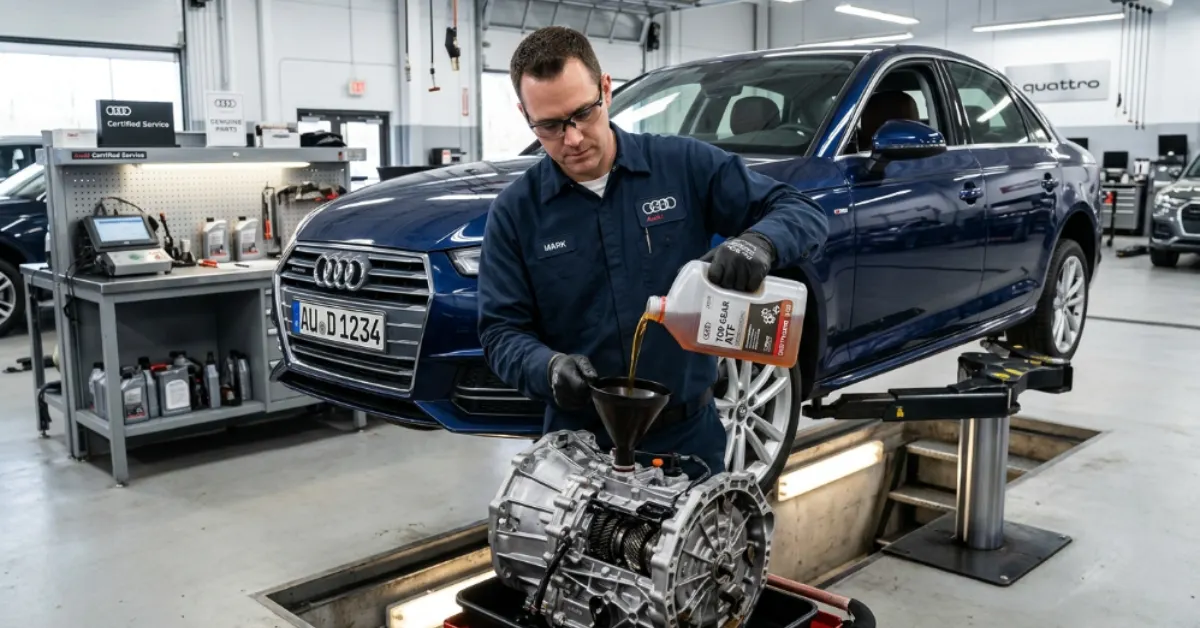
In practice: service to the shorter end of the recommended interval, never mix specifications, avoid the driving habits that add unnecessary heat, and have the fluid condition inspected at every routine service rather than only when something feels wrong. When it is due, an OEM-specification oil change with the correct volume and a post-service adaptation reset is what keeps a gearbox at its designed service life.