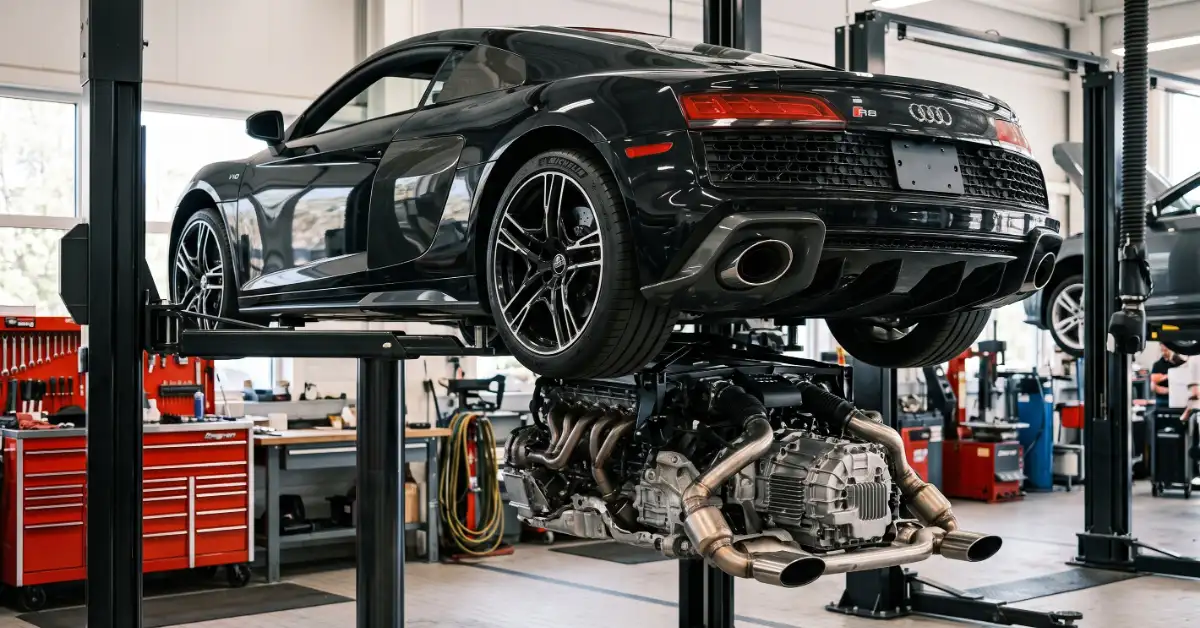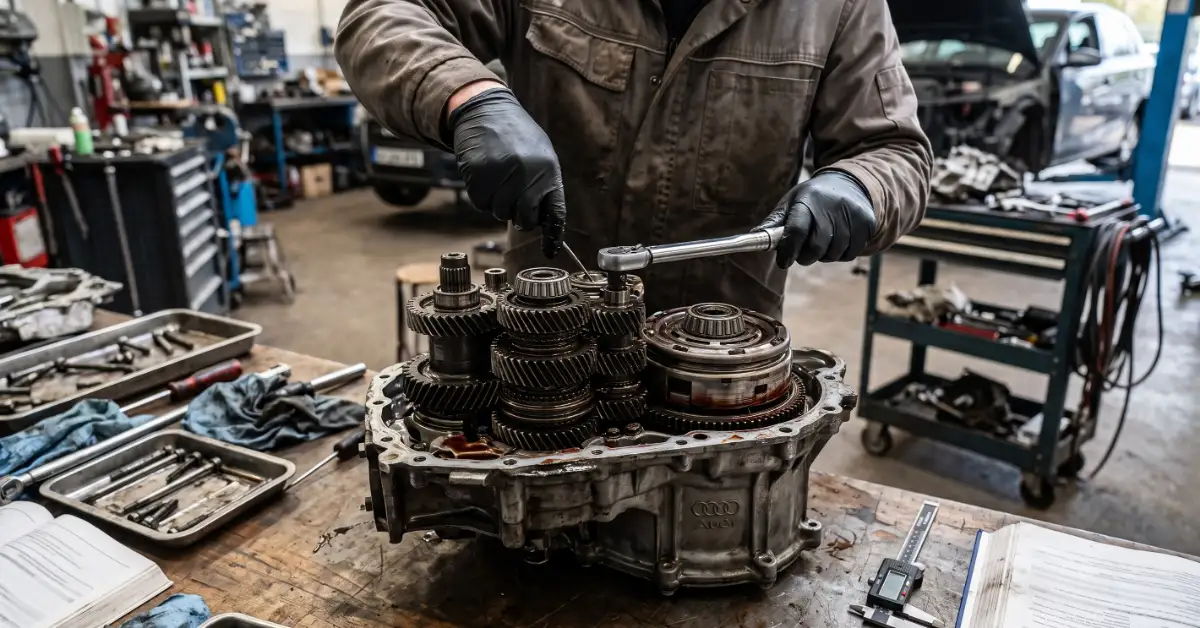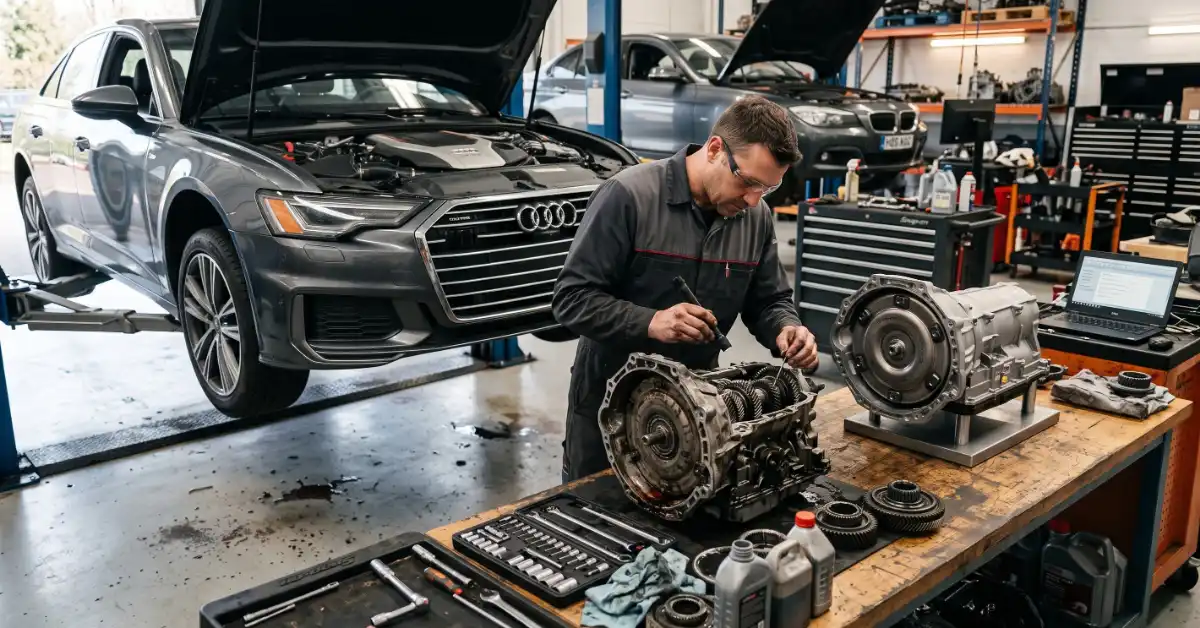
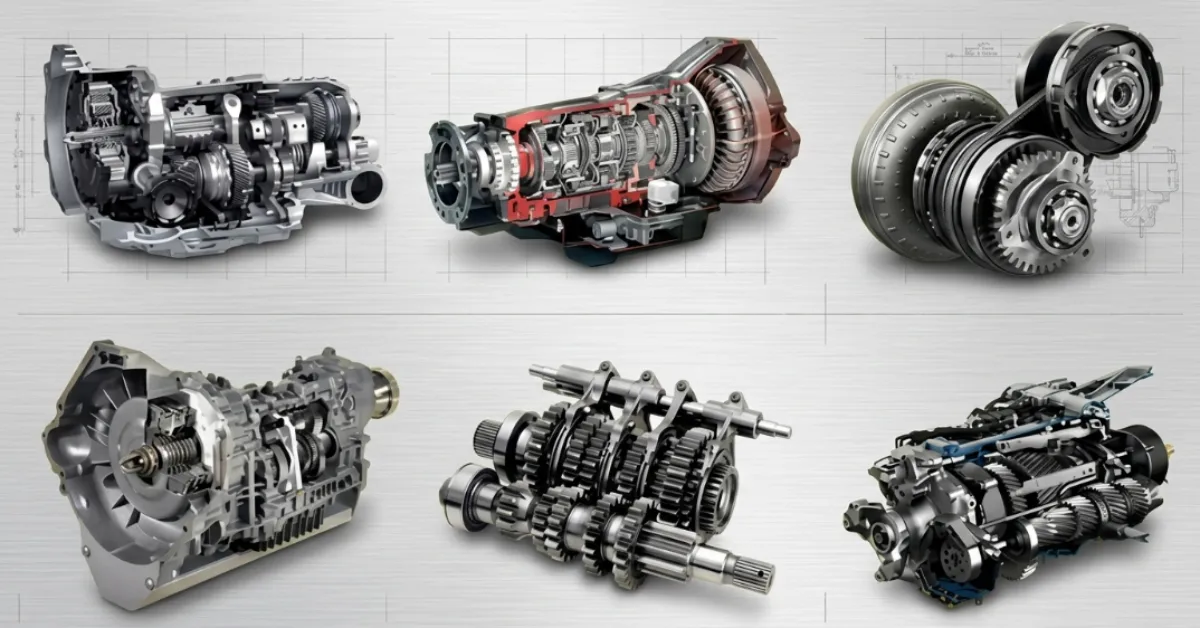
Audi has fitted a wider range of gearboxes than almost any other manufacturer at this level: torque-converter automatics, dual-clutch S tronic units, the Multitronic CVT, conventional manuals, and Tiptronic control layered over several of them.
Knowing exactly which one is in your car is not trivia. It determines the service interval, the fluid specification, the likely failure mode and the cost of putting it right. It also determines how well the car copes with Abu Dhabi conditions, because these platforms are not equally tolerant of heat and stop-start running.
Torque-Converter Automatics
The most widely used family in modern Audis. Gears change automatically through a torque converter and a set of planetary gears, with no clutch pedal and no driver input required.
ZF 8-speed (8HP). Developed by ZF Friedrichshafen and fitted across the A6, A7, A8 and Q7. Eight ratios keep the engine in its efficient band, which helps both economy and smoothness. It is the most robust automatic Audi currently uses and copes well with local conditions, provided the fluid is changed. The "sealed for life" reading of the service schedule does not survive contact with 45°C ambient temperatures.
Earlier torque-converter units. Older cars used 4- and 5-speed versions, moving to 6-speed and then 8-speed for efficiency. Smooth and durable, and generally forgiving.
6-speed (09L / 6HP). Common from the early 2000s to the mid-2010s in the A4, A5, A6 and Q5. Dependable over long service lives and still very much on the road here.
S tronic Dual-Clutch Units
Audi's dual-clutch family. Two clutches work in tandem, one on the odd gears and one on the even, so the next ratio is engaged before the shift is called for. The result is a change measured in hundredths of a second with no interruption to power.
7-speed DL501 (0B5). The common quattro unit, found in the A4, A5, A6 and Q5 with four-wheel drive. A wet-clutch design, so the clutches run in oil for cooling and durability, and it handles high torque well. Mechatronic problems are the known weakness at higher mileage, which makes fluid servicing the deciding factor in how long one lasts.
6-speed DQ250. A wet dual-clutch used in transverse front-wheel-drive models: the A3, A1, TT and Q2. Compact, efficient and quick-shifting, and generally the most durable of the transverse units in traffic.
7-speed DQ200 (dry clutch). Lighter and more economical because the clutches are not oil-cooled. That is exactly why it is the least happy of the family in heavy traffic: without oil cooling, repeated low-speed engagement puts heat straight into the clutch. Early versions were jerky at low speed and were improved by software updates. In Abu Dhabi stop-start conditions this is the gearbox that most rewards a specialist eye.
Multitronic CVT
The Multitronic uses no fixed gears at all. A steel push belt runs between two variable-width pulleys, changing ratio continuously so the engine can hold its most efficient speed.
Multitronic 01J. Fitted to front-wheel-drive A6 models from the late 1990s to the mid-2000s. Very smooth and economical, but not designed for high torque, and reliability concerns around the chain and valve body eventually ended its use.
Why Audi moved on. By the early 2010s the S tronic shifted faster and handled more power, and the CVT had acquired a reputation for expensive repairs. If you still run a Multitronic car, fluid discipline is not optional. The belt and pulley design depends on it, and wear past a certain point is not economically repairable.
Manual Gearboxes
The most direct option, and still the cheapest to maintain.
5-speed. Common in 1980s and 1990s cars including early A3, A4 and the 80 series. Simple, repairable and reliable.
6-speed. Replaced the 5-speed in the A3, A4, TT and some A5 models. The extra ratio helps motorway economy, and it remains an option on a few current cars.
In local traffic the clutch is the consumable. Repeated pull-aways in slow-moving queues put heat through the friction plate, and heat is what ends clutch life, not mileage.
Tiptronic
Tiptronic is not a gearbox in its own right but a control mode layered on Audi's automatics. Move the lever across or use the paddles and you select ratios yourself, without a clutch pedal.
The gearbox still protects the engine, shifting automatically if you hold a gear too long or rev too hard. It is available widely across the automatic range including the A4, A6, A8 and the Q models. Used sensibly it is genuinely useful here, since holding a lower gear on a descent or when loaded keeps the converter out of its slipping range.
Quattro and Gearbox Compatibility
Audi's quattro system and the transmission are closely matched, and not every gearbox pairs with every drivetrain. The wet-clutch S tronic is built for longitudinal quattro layouts, the dry-clutch version for smaller transverse installations, and the ZF 8-speed pairs with the larger quattro models.
This matters for repair as much as for specification: parts, fluid volumes and adaptation procedures differ between them, which is why a workshop needs the right diagnostic platform rather than a generic scan tool. Understanding how the mechatronic unit commands each shift makes the differences between these platforms much easier to follow.
Which Platforms Struggle Most in Abu Dhabi
Ranked by how much local conditions shorten their life:
- DQ200 dry-clutch S tronic. No oil cooling for the clutches, and constant low-speed engagement in industrial-estate traffic is its worst case.
- Multitronic CVT. Unforgiving of the wrong fluid or a stretched interval, and expensive when the chain goes.
- DL501 wet S tronic. Durable, but the mechatronic unit sits in the hottest part of the assembly and degraded fluid takes it out.
- ZF 8HP and older torque-converter units. The most tolerant, though the converter still generates its heat exactly where traffic makes it slip.
Whatever is fitted, the pattern is the same: heat and fluid condition decide the outcome, not the badge. That is the argument for using technicians trained on all four gearbox families rather than a general garage that treats every automatic the same way.
If you want the underlying mechanics before choosing a service schedule, start with what an Audi transmission is and work forward from there.
If you are weighing one platform against another rather than identifying the one you already own, how the three types compare sets them side by side on performance, comfort and running cost.