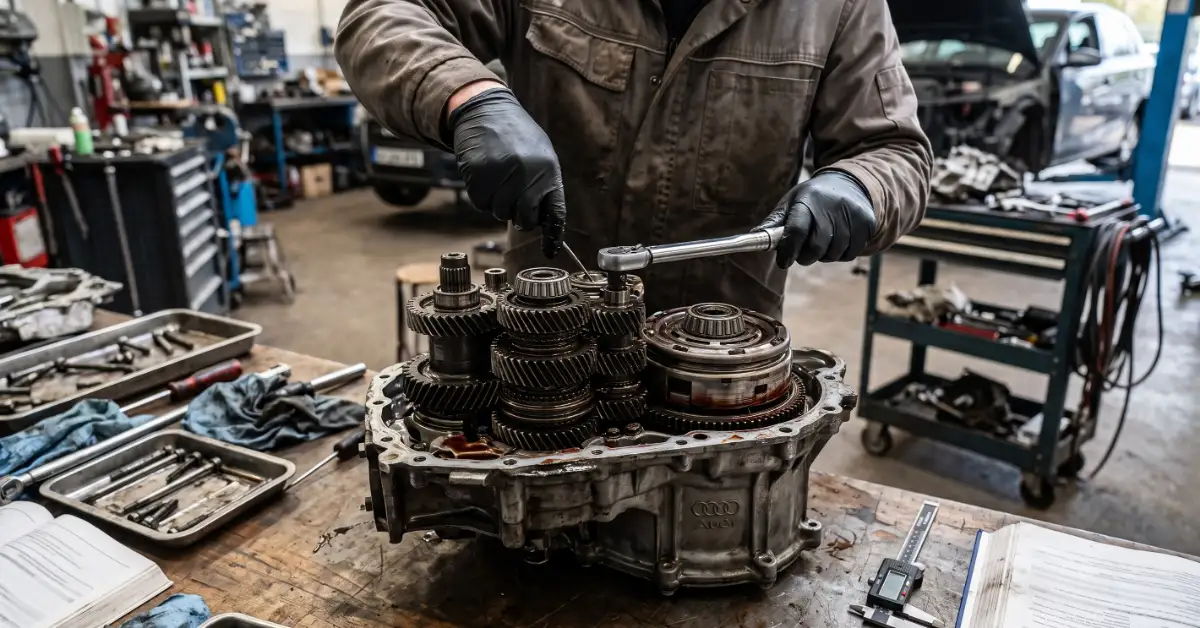

The transmission is one of the hardest-working assemblies in the car and the least visible. Without clean oil it overheats, wears, and eventually presents a bill that dwarfs anything else on the maintenance schedule.
The job itself is well defined: lift the car safely, drain the old oil from the drain plug, remove and clean the transmission pan, fit a new filter, refill with the correct Audi fluid, and check for leaks. Done properly and on time, it is the single most effective thing you can do to keep an Audi gearbox healthy, particularly one living in Abu Dhabi heat, where fluid ages faster than any service book assumes.
What the Oil Is Doing
Transmission oil does more than keep parts slippery. It cools the gearbox, protects metal surfaces from wear, and carries the hydraulic pressure that lets gears change without jerking or delay.
It degrades on two fronts at once: heat breaks the fluid down chemically, and normal operation loads it with fine metal particles. Past a certain point it stops doing its job, and the results follow a predictable order: slow shifts, then unusual noises, then failure. Audi builds these gearboxes around high-performance components with tight tolerances, which is exactly why they are unforgiving about fluid condition.
Tools and Materials
Gather everything before starting; a half-drained gearbox is a bad time to discover a missing part.
Tools: car jack and jack stands, drain pan, socket wrench set, torque wrench, funnel.
Materials: Audi-approved ATF, a new transmission filter, a new drain plug gasket, and clean rags or shop towels.
Fluid choice is the part with no margin for error. Confirm the specification against the owner's manual or with a technician who knows the platform before buying anything, and picking a compatible ATF covers how to match the approval number to your gearbox rather than to the model badge.
The Procedure
Step 1: Lift the car and drain the old fluid. Park on a flat surface and let the engine cool. Raise the car with a jack and support it on stands under the frame. Slide the drain pan beneath the transmission drain plug, remove the plug with the correct socket, and let the old fluid drain completely. Dark colour or a burnt smell confirms the change was overdue. Refit the plug with a new gasket and torque it to specification.
Step 2: Remove and clean the pan. Not every Audi has a removable pan; where yours does, this step matters. Undo the bolts and lift the pan away carefully, since residual fluid will come with it, so keep the drain pan underneath. Clean out any sludge and metal debris, and inspect the pan for cracks or damage before it goes back on. What sits on the pan magnets is a useful read on the gearbox's internal condition.
Step 3: Replace the filter. Inside the transmission sits a filter that catches particles from the fluid. On most Audi models it either pulls out or unscrews. Fit the new one in the same position and confirm it seats firmly. A clogged filter restricts flow and loads the transmission unnecessarily, so replacing it during an oil change is always worth doing.
Step 4: Refill. Refit the pan with new bolts or a fresh gasket as required. Locate the fill port, usually on the side of the gearbox, and add the correct volume slowly through a funnel; the manual carries the exact capacity. Start the engine and let it warm through. With the car in park, shift through each gear position to circulate the fluid, then re-check the level and top up as needed.
The fluid change procedure covers the same job from the workshop side, including how sealed gearboxes differ.
Signs the Change Is Already Overdue
- Rough or jolting shifts. Worn fluid loses its ability to reduce friction, and every gear change feels it.
- Delayed response when shifting. A pause after selecting Drive means hydraulic pressure has dropped.
- Dark, dirty or burnt-smelling fluid. Healthy ATF is bright red and odourless. Dark brown or burnt fluid has broken down completely.
- Unusual noises. Whining, humming or clunking during shifts means the fluid is no longer lubricating properly, and these get worse, not better.
- A dashboard warning light. Audi's sensors monitor transmission behaviour; degraded or low fluid is a common cause.
- Slipping gears. High revs without matching acceleration means the fluid cannot hold the pressure needed to keep gears engaged.
- Overheating. Old fluid absorbs heat poorly. A burning smell or a temperature warning needs immediate attention.
- Shuddering at low speed. Contaminated fluid creates inconsistent pressure, and the vibration at idle or crawling speed is the result.
In Abu Dhabi these symptoms tend to arrive earlier in a car's life than the mileage suggests they should. Sustained ambient heat and the stop-start running typical of journeys through Musaffah and the industrial districts keep the gearbox in its hottest operating band, so treat any of the above as a prompt rather than something to monitor.
Doing It Yourself or Booking It In
This is achievable at home with the right tools and a careful approach, and the four steps above are the whole job on a car with a conventional pan and dipstick.
Two things change that calculation. Sealed transmissions have no dipstick, and the final level has to be set at a specified fluid temperature measured with a diagnostic scanner. Get that wrong and the gearbox ends up underfilled even though the volume looked right. And a technician doing the work will notice what a driveway service does not: leaks developing, wear debris on the magnets, and whether the shift quality afterwards is genuinely back to normal.
If you would rather have it done properly the first time, the oil change service we run in Abu Dhabi uses OEM-specification fluid and verifies the level at temperature. For anything that already feels like a fault rather than a service item, it is worth starting with an Audi workshop rather than a general garage, because the diagnostic scan usually costs less than the parts a guess would replace.